
Alabama State Parks Continues Accessibility Efforts

hopper

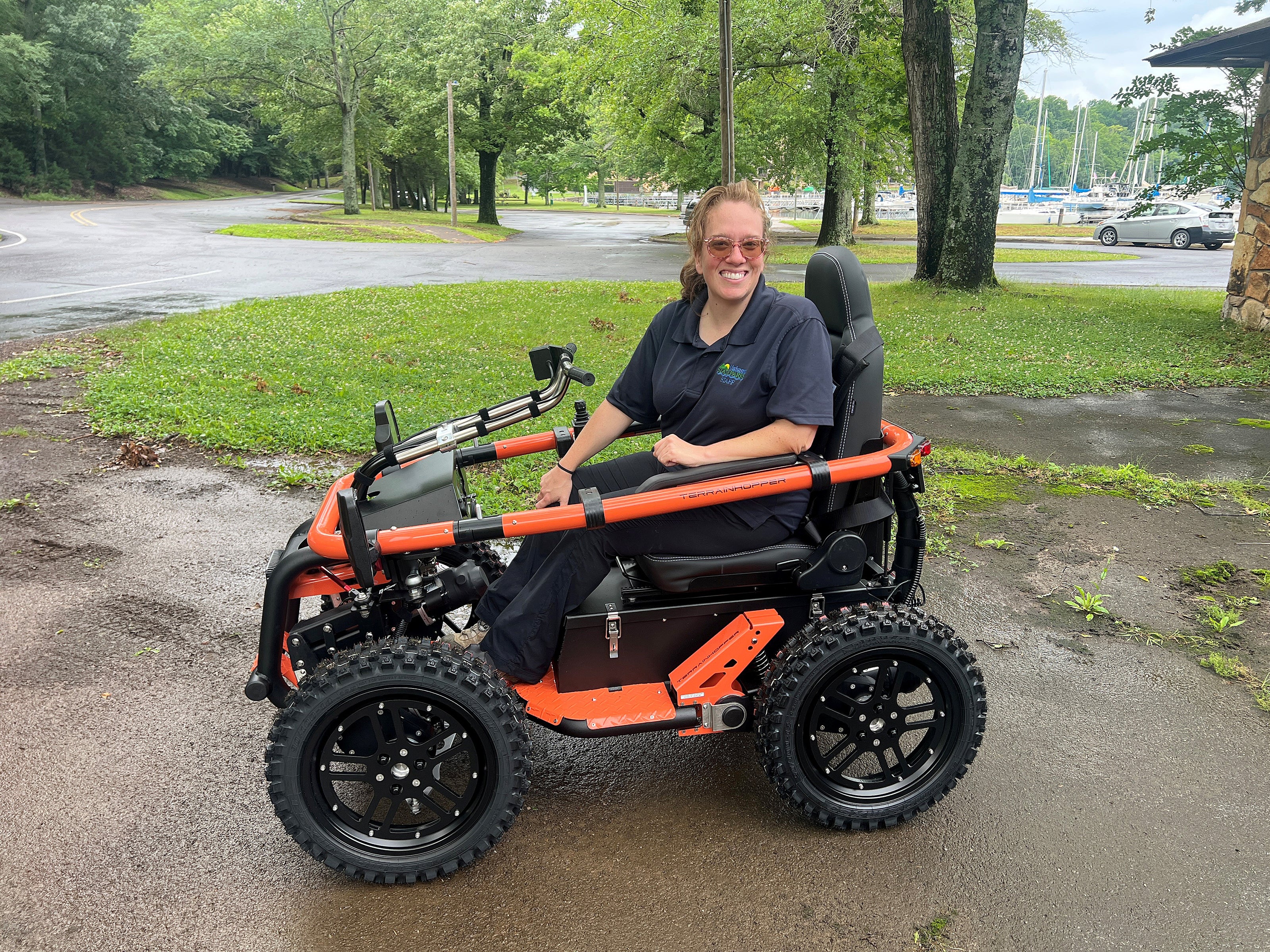
Alabama State Parks Northwest District Naturalist Amber Coger shows off the TerrainHopper mobility vehicle now available at Joe Wheeler State Park. ADCNR photo

By DAVID RAINER, Alabama Department of Conservation and Natural Resources

Accessibility is a key initiative spreading throughout the region with a focus on the outdoors at Alabama State Parks, where a recent donation expanded the possibilities for those with physical challenges.

A TerrainHopper was donated by the Alabama Mountain Lake Tourist Association (AMLA) to Joe Wheeler State Park in northwest Alabama and is designed to help a physically challenged person navigate rugged terrain, such as Joe Wheeler’s Awesome Trail.

“North Alabama is leading a significant effort to enhance accessibility,” said Chad Davis, Assistant Director of the Alabama Department of Conservation and Natural Resources’ (ADCNR) State Parks Division. Chairman of mountain lake executive committee. “I’m proud to chair of the executive committee of Alabama Mountain Lakes Tourist Association, where they are working hard on these initiatives, such as providing the TerrainHopper that will allow individuals with mobility challenges to explore our trails at Joe Wheeler State Park.” 

“We have so many beautiful and spectacular state parks,” said Conservation Commissioner Chris Blankenship. “We want all our citizens to be able to enjoy these special places, no matter their physical abilities.”

According to TerrainHopper, it is an electrically powered off-road mobility vehicle with innovative technology and performance. With a ground clearance of nearly 10 inches and a 35-degree climbing capability, our vehicles are engineered to conquer deep mud, soft beach sand, snow, rocks, steep hills and many other obstacles. Some people have called our all-terrain mobility vehicle a “mini Land Rover.”

Tami Reist, AMLA’s President and CEO, said she was inspired by presentations on accessibility she saw at an international travel show to make areas in her region more available to those with physical challenges. 

“I thought, ‘We could do this,’” Reist said. “We started this journey little over year ago.”

Reist made a call to TVA (Tennessee Valley Authority) to discuss a possible grant for a mobility device.

“A friend of mine at Bear Creek had taken over Overton Farm and was making it into a school outing place, and they’re making it accessible,” she said. “They had gotten a grant for this type of vehicle.

“So, we purchased the same type of vehicle, and I want to give it to one of our state parks. We gave it to Joe Wheeler. We had applied for a grant with Innovate Alabama. If we get that grant, it will allow us to put those same vehicles in places like Monte Sano State Park and DeSoto State Park. Some parks have some devices, but this just gives another opportunity for people with physical challenges to get out and see our beautiful north Alabama terrain.

“Chad was so excited about getting the TerrainHopper, and he was amazed at how great it did.”

Reist said AMLA just got a grant for 38 wheelchairs that will be dispersed to the visitors’ bureaus in north Alabama, and the Alabama Mountains, Rivers & Valleys Resource Conservation & Development Council awarded AMLA with a grant for Meta Smart Glasses. 

“We’re giving those smart glasses to the Hellen Keller Home (Tuscumbia, AL) to give the end user the opportunity to be able visualize and hear the story of Helen Keller,” said, Reist, who is also identifying accessibility needs for hotels and venues that currently have limited access. 

“We’ve trained 300 people in accessibility,” she said. “Accessibility needs are different. They are learning how to work with people in this environment and open up those opportunities.

“We’re starting to see more accessibility playgrounds and waterparks. We’re really excited about this growing effort. We’re glad to be doing it.”

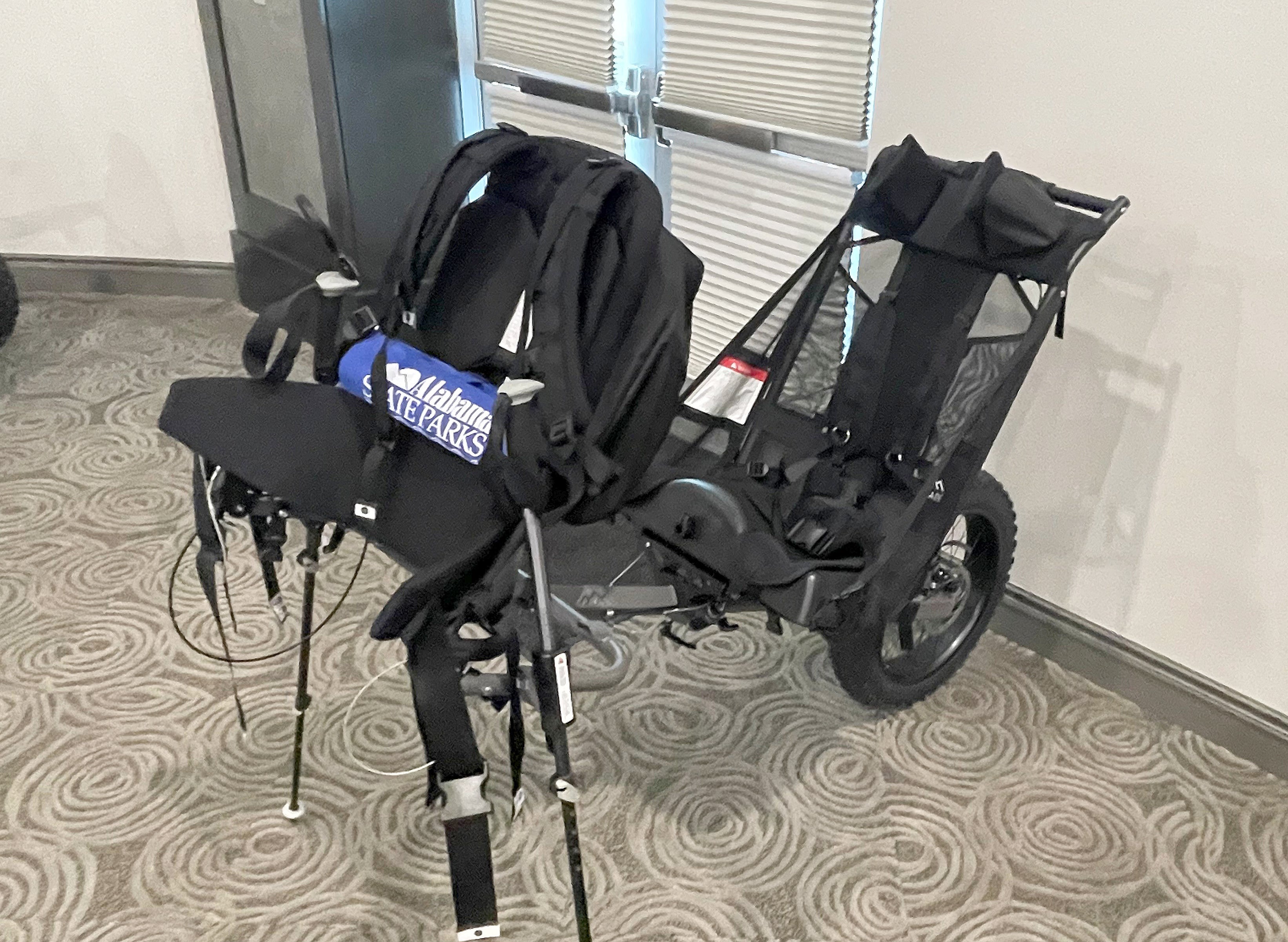
The VertaCat device allows physically challenged individuals to continue to play golf. ADCNR photo

Oak Mountain State Park near Pelham has three different mobility devices – the Action Trackchair, the Huckleberry Cascade Cart and the VertaCat for physically challenged golfers.

The Action Trackchair provides access to certain trails and green spaces. According to Action Trackchair, the mobility device is built to “get you where you need to go, have the adventures you want while you’re there, and safely return home.” The AXIS chair has a redesigned motor that ensures an increase in speed, allowing the user to cover more ground. The redesigned frame is streamlined to reduce rolling resistance which results in improved range. Six independent adjustment points throughout the seat allow for a perfect fit.

The Huckleberry Cascade Cart from Huckleberry Hiking is designed to attach to an able-bodied hiker, who then tows the physically challenged individual (up to 150 pounds) or a child on the trails and other outdoor spaces. The cart is designed so that the lead hiker only feels 25% of the weight of the person being towed.

The VertaCat was designed by a paraplegic athlete who wanted to play golf. The mobility device doubles as a cart to traverse the golf course. Then the golfer can use the electric stand-up assist to raise the person into position to hit the golf ball. Another feature allows the golfer to fine-tune his position in relation to the ball.

At Gulf State Park, the Action Trackchair is available as is the GRIT Freedom Chair, a stabilized wheelchair with levers the user can push and pull to propel the chair.

State Parks Director Matthew Capps also thanked the Alabama State Parks Foundation for their contributions to the accessibility effort.

“The Alabama State Parks (ASP) Foundation is leading a transformative initiative to elevate the guest experience by placing off-road mobility devices in every one of our parks,” Capps said. “Thanks to generous private support, guests at Gulf State Park now have access to a Trackchair, and Oak Mountain State Park offers a TerrainHopper that opens the outdoors to more people than ever before. The ASP Foundation and Community Foundation of Greater Birmingham helped with funding to build two accessible playgrounds at Rickwood State Park, and we are working on a playground at Joe Wheeler thanks to the Daniel Foundation and the Thompson Tracker Foundation.

“If you, your business, or your civic organization want to make a meaningful impact and help expand access to Alabama’s natural wonders, please visit the Alabama State Parks Foundation website at https://asparksfoundation.org/. Together we can create a more inclusive outdoor experience for all.”

Davis said as the American population grays, he expects the demand for these devices to continue to climb.

“All of us one day we are not going to be the most able-bodied person,” Davis said. “As the world ages, we want to make sure we have something for folks where it doesn’t matter what your abilities are, you can use one of these devices to enjoy nature. We want people to not be limited to just driving in a car. We want them to be able to get off the concrete roads and paths and get out on the actual trails and into the woods. That’s important to us. We want to provide some access to the outdoors for everyone.”

Those interested in using one of the mobility devices can go online at www.alapark.com/outdoor-mobility-devices to learn more about the devices and how to reserve them at Joe Wheeler, Gulf, Monte Sano, Lakepoint and Oak Mountain state parks.

“Once you reserve the device and arrive at the park, you can head to the designated facility to pick it up and start using it,” Davis said. “That process applies to every park that is offering an outdoor mobility device.”

###

The Huckleberry Hiking Cart allows an able-bodied hiker to pull a child or physically challenged person along the state park trails. ADCNR photo

Written by

David Rainer
Outdoor Writer
Back To News