
CAB Honors Blankenship, Changes Turkey Season Dates

Chris

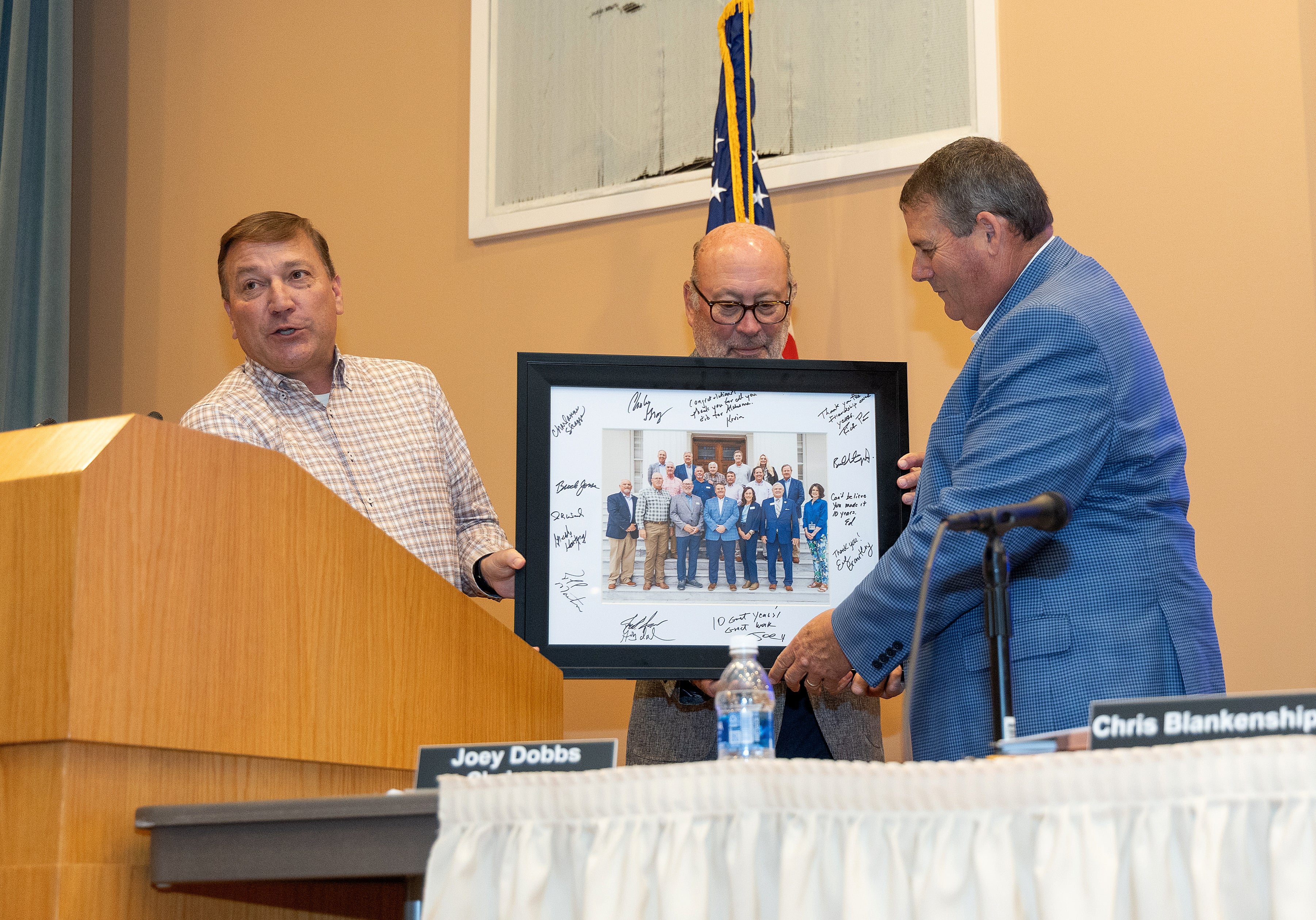
Conservation Advisory Board members Raymond Jones, left, and Joey Dobbs present Conservation Commissioner Chris Blankenship with a signed photo of the Board outside the State Capitol. Photo by Kate Stone

By DAVID RAINER, Alabama Department of Conservation and Natural Resources

The Alabama Conservation Advisory Board met for its final time in 2026 and paid tribute to Chris Blankenship, Commissioner of the Alabama Department of Conservation and Natural Resources (ADCNR), whose tenure will end with the Governor Kay Ivey administration in January 2027.

The Board also approved changes to the turkey season with an earlier opening date and placed the Talladega National Forest inside Talladega County on the dog deer hunting permit system.

A resolution was adopted by the Board recognizing Commissioner Blankenship’s contribution to the expansion of outdoor opportunities throughout the state with greater access to Alabama’s great outdoors.

Board member Raymond Jones read the resolution and highlighted the many aspects of Commissioner Blankenship’s connection to the outdoors with his move to Mobile at age 3 and subsequently Dauphin Island, where he started work on a charter boat at age 14. After obtaining his bachelor’s degree from the University of South Alabama in political science and criminal justice, the Commissioner was hired by ADCNR’s Marine Resources Division (MRD), where he worked his way through the ranks to become MRD Director, a position he held for seven years. He was promoted to ADCNR’s Deputy Commissioner before becoming Commissioner in August 2017.

The Commissioner holds or has held positions on numerous boards, including the Forever Wild Land Trust Board (chair), Mobile Bay National Estuary Program (co-chair), Gulf States Marine Fisheries Commission (past chair), Alabama Seafood Marketing and Testing Commission (program administrator), Innovate Alabama’s Outdoor Recreation Council (chair), Alabama State Parks Foundation, Alabama Black Belt Adventures and Alabama Historical Commission.

Jones also pointed out the Commissioner’s integral role in the state’s recovery from the Deepwater Horizon oil spill, serving as Governor Kay Ivey’s designee on numerous entities to acquire funding through federal sources to restore natural resources damaged by the spill and to increase Alabama’s resilience to natural disasters. The Commissioner also helped manage projects administered with Gulf of Mexico Energy Security Act (GoMESA) funds. These efforts have resulted in 247 projects that totaled $1.5 billion for coastal Alabama.

“Since his appointment as Commissioner in 2017, the Alabama Department of Conservation and Natural Resources has invested more than $525 million in outdoor recreation improvements, including more than $300 million in Alabama State Parks enhancements, $76 million in beach renourishment, more than 50 boating access improvement projects and significant artificial reef enhancements,” Jones read. “The Department has partnered with various organizations to acquire more than 100,000 acres of land across the entire state of Alabama for public access, protecting sensitive habitat, supporting endangered species and expanding recreational opportunities.”

Commissioner Blankenship responded by thanking the ADCNR staff for their work to support those accomplishments during his tenure. He highlighted additional achievements: implementation of a sandhill crane season, the expansion of the deer bag limit to two does per day, expansion of the alligator season in bag limits and areas, the creation of new Special Opportunity Areas (SOAs) and expansion several wildlife management areas (WMAs), a new licensing system that will be more user-friendly and be in place for the new license year, shooting range improvements, nighttime hunting for coyotes and feral swine, the baiting license privilege, physically disabled and veterans licenses, state management of the red snapper fishery, the reef fish endorsement, the reservoir management program, speckled trout and flounder management, and eight new artificial reef zones. The Commissioner also thanked former Commissioner Gunter Guy for giving him the opportunity to become Deputy Commissioner and Governor Ivey for having the trust in him to appoint him as commissioner in 2017.

The Commissioner also noted staff accomplishments that typically go unnoticed.

“This is something you don’t get much press about when you do it right, but we have completed more than a dozen audits over the last nine years with no major findings, at all,” he said. “Handling hundreds of millions of dollars and thousands of pieces of equipment through multiple divisions, I think that one thing deserves a hand for our staff.

“We successfully managed through COVID. In fact, we thrived during COVID. Governor Ivey added outdoor recreation as an essential activity for our state. We had more people visit our parks that year than any year before, and we sold a lot of hunting and fishing licenses. People got out and enjoyed the outdoors when they couldn’t participate in other activities. That seems like a lifetime ago, but that was really a trying time for our staff to figure out how to do things in a safe way and be able to get the public out to our facilities.”

Charlanna

Deputy Commissioner Charlanna Skaggs updates the Board on new legislation that affects ADCNR. Photo by Kate Stone

Commissioner Blankenship highlighted some of the recent events that resulted from years of construction upgrading facilities, resources and opportunities. He pointed out the work done at Lake Lurleen State Park, Joe Wheeler State Park, Monte Sano State Park, the refurbished boat ramp at Billy Goat Hole on Dauphin Island, the Event Center at Chewacla State Park, Lakepoint State Park, a connector road at Rickwood State Park, boat ramp expansion at Kowaliga Boat Ramp on Lake Martin, Fairhope Park and Pier, Bayfront Park in Mobile County, and Little River State Park in Escambia County.

Two larger State Parks projects are slated to be completed by this summer, including the Executive Campground at Gulf State Park and the hotel and facilities at Cheaha State Park with an overlook from the highest point in Alabama. He said reservations were opened last week for the Executive Campground and more than $200,000 worth of camping fees have been booked. 

“Also, the Governor’s One-Shot Turkey Hunt was held early in April,” the Commissioner said. “We hold that every two years and use that as a fundraiser for the Alabama Conservation and Natural Resources Foundation and as an economic development tool for our state as we bring in CEOs and venture capitalists. This gives people who are interested in Alabama an opportunity to come see what Alabama has to offer. It was extremely successful, and I would like to recognize our Assistant Deputy Commissioner Billy Pope and his staff for the great job of organizing that and putting that on.”

The Commissioner celebrated the kickoff of Alabama State Parks’ Junior Ranger program throughout the 21 State Parks.

“That has been very well received by the public, especially the children,” he said. “It’s a great way for us to teach environmental education to get those kids involved in managing the resources and develop an appreciation for the resources at a very young age.”

Deputy Commissioner Charlanna Skaggs updated the Board on several pieces of legislation that passed this past session that impact ADCNR. The Gulf of Mexico was renamed the Gulf of America. A Seagrass and Sea Oats Task Force was formed, and a bill establishing the beneficial use of dredge material in Mobile Bay. A lifetime disabled hunting and fishing license was established, and $1 million was allocated for Alabama’s Wildlife Action Plan in the state General Fund budget.

Also, the Dam Safety Program was passed and will be administered by the Alabama Emergency Management agency. Deputy Commissioner Skaggs pointed out that ADCNR is one of the largest dam owners in Alabama, and the legislation will allow the Department to apply for federal funds for dam repairs and replacement.

The Commissioner also addressed the dog deer hunting situation in and around the Talladega National Forest, where ADCNR and the Board have fielded numerous complaints over the years.

Board member Jeff Martin made a motion to put the Talladega National Forest in Talladega County on a special dog deer hunting permit system for public safety and management of user conflicts. The Board approved the motion unanimously.

“We have had certain issues during the 33 years that I’ve been with the Department of Conservation that deal with dog deer hunting,” Commissioner Blankenship said. “It is light years better than it was 33 years ago. It is better than just a few years ago, but we still have issues in certain places. 

“At our first meeting, we had people speak who had issues, primarily around the Talladega National Forest. As a Department and Board, we have really four options around the Talladega National Forest. We could do nothing. We could leave like it is and hope for the best. It has been my experience that hope is not a strategy and doesn’t work out very well. We could close the entire county to dog deer hunting. That is an option. We could do a statewide permit system, which was mentioned as a possibility at previous meetings. In places that are not having problems, putting them on a permit system does seem to be unnecessary and is not the least intrusive way to handle this.”

The Commissioner said the fourth option is to require a special permit in Talladega National Forest, similar to what has been done at Homochitto National Forest in Mississippi. He said the permit would be issued on an individual basis with permit numbers applied to vehicle used during the hunt. Dogs would be required to wear GPS and correction collars with the permit number on them. The first violation would suspend the permit for a certain number of days. A second violation would result in a permit suspension of one year. Subsequent violations would result in the revocation of the permit.

As for the turkey season changes for the 2027 season, the spring starting date for most of the state will move earlier by five days to March 20 and run through May 3. In Zone 2 in the northwest corner of the state, the spring season will start on March 27 and run through May 3. The spring season for wildlife management areas (WMAs) and U.S. Forest Service Ranger Districts will have earlier opening dates as well. The Lauderdale, Freedom Hills, Coon Gulf, Riverton CHA and Martin CHA WMAs will open March 27 and run through May 3, while the remaining WMAs that allow turkey hunting and Ranger Districts in the state will open March 20 and run through May 3.

Also, restrictions on the use of turkey decoys have been removed; hunters can use decoys all season. The bag limit of one gobbler per day with a season limit of four remains unchanged.

The Board also approved the addition of fluorescent pink as an approved hunter safety color.

###

turkey

The Conservation Advisory Board approved changes to the 2027 spring turkey season that moved the opening date five days earlier. Photo by David Rainer

Written by

David Rainer
Outdoor Writer
Back To News