By DAVID RAINER, Alabama Department of Conservation and Natural Resources
An aquaculture project funded during former Alabama Senator Richard Shelby’s tenure in Washington has finally been revived in Gulf of America’s nearshore waters off Alabama.
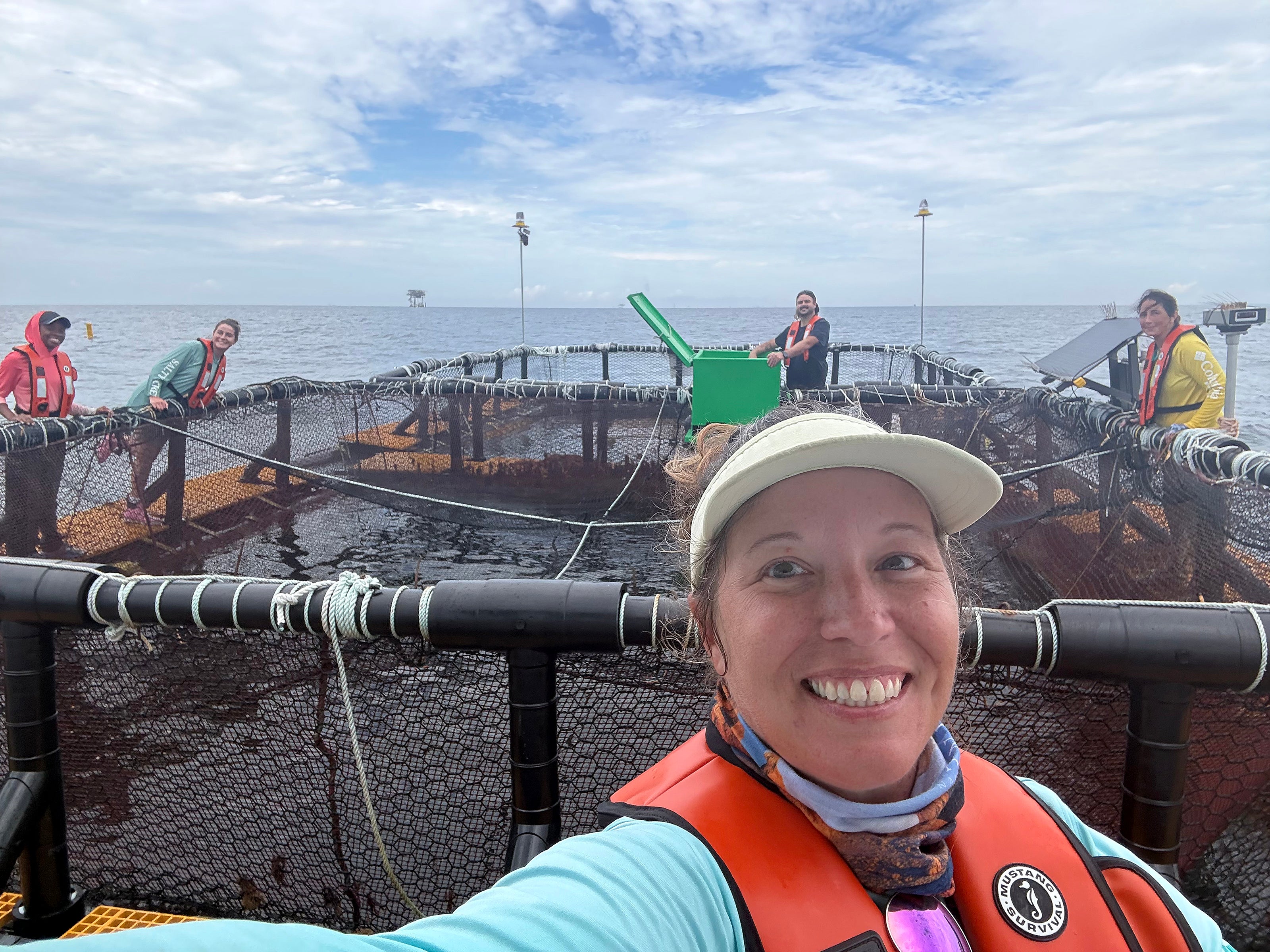
Last year, a platform and fish pen were erected and moved into place about 2 miles off Fort Morgan to study the feasibility of raising finfish to marketable size along with other species like oysters and seaweed.
A little more than a year ago, marine biologist Ashley McDonald returned to the Dauphin Island Sea Lab to become the Integrated Multitrophic Aquaculture Project Manager. She is leading a team in this effort to provide an additional protein source to the public.
“This project has basically been dead in the water, waiting on permits and agreements,” McDonald said.
The project received a protected species agreement from NOAA (National Oceanic and Atmospheric Administration). Permits were also acquired from the Alabama Department of Conservation and Natural Resources’ (ADCNR) State Lands Division, the U.S. Army Corps of Engineers and the U.S. Coast Guard.
“This project is intended for more localized, small-form aquaculture,” McDonald said. “It would be more individually owned and operated. It’s not one of these big, massive aquaculture projects, the idea being that we wanted to incorporate local native species with intrinsic market value for Gulf species locally. We wanted to provide an avenue for smaller commercial harvesters that might be looking into branching out into aquaculture or subsidizing any of their commercial revenue and doing it in a way that it doesn’t feel like it’s competing with commercial harvest.”
McDonald said safeguards will be used to ensure the project is sustainable and environmentally responsible.
“We want to minimize the effect of excessive nutrient pollution that is associated with the much larger farms,” she said. “This comes from wasted feed, incorrect feeding rates and excess nutrients from the fish.”
This idea of small-form aquaculture actually came from an area far removed from the Gulf. A group from Canada developed the idea. A New Hampshire aquaculture operation’s business plan that includes steelhead trout, blue mussels and kelp is the model for the efforts in the Gulf.
“We are using three species that we are growing out,” McDonald said. “We have our finfish, which is red drum. We also have hanging baskets with oysters and macro algae, a seaweed. They are all native species. Their genetic component is local to Mobile Bay, so these are local, homegrown animals.
“The idea for the oysters and seaweed (graceful red weed) is they are going to take up and absorb the particulate organic matter and inorganic matter, like dissolved nitrogen and nutrients. They also become a secondary product for the farmer to take to market. Right now, the seaweed is one we really don’t have a market for. Seaweed farming is new. It’s taking off, but it hasn’t quite found its market yet.”
Since the platform was deployed in the fall of 2025, the team has learned a lot about the environment in the Gulf, its benefits and pitfalls.
“The platform is a 55 feet by 20 feet rectangle with two fish bays and sits in about 33 feet of water,” McDonald said. “The conditions out there are pretty consistent in terms of salinity. It’s pretty much open water salinity out there. The entire footprint is about 3 acres, but that includes the mooring. The mooring lines are the majority of the system. It uses a four-point mooring system to keep it in place against all types of weather conditions because it gets really rough out there, we’re finding.”