
By DAVID RAINER, Alabama Department of Conservation and Natural Resources
Many deer hunters these days are focusing on mobility to be able to reach those places back in the woods where few humans venture.
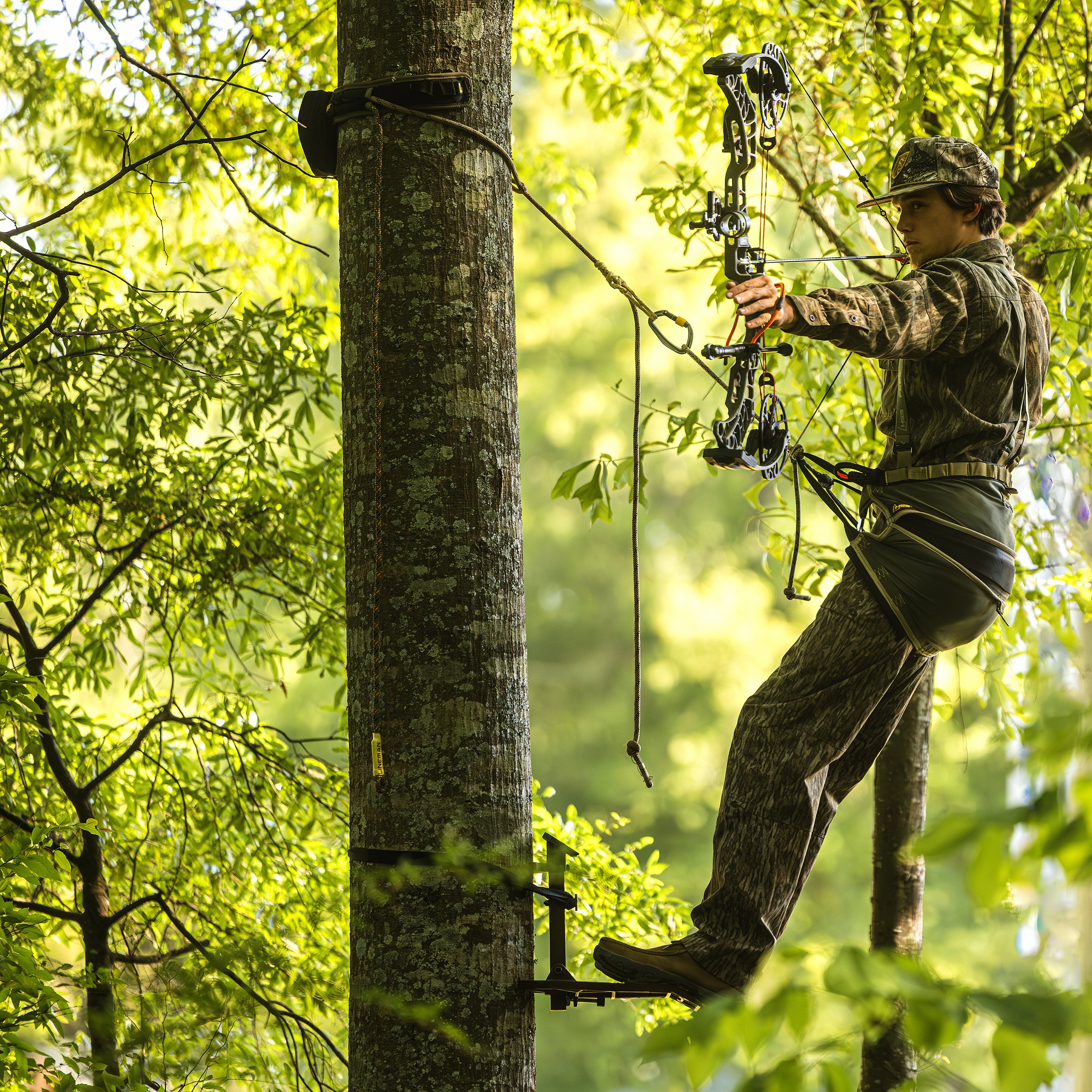
Instead of lugging full-size climbing stands more than a mile into the woods, those hunters are opting for a minimalistic approach, which is where saddle hunting comes in.
One of my colleagues at the Alabama Department of Conservation and Natural Resources (ADCNR) had mentioned saddle stands, and I got to check out one option at last week’s Buckmasters Expo at the Montgomery Civic Center.
Joe Laseter of HSS, an Alabama company, said the saddle stand has been out for more than a decade, but it has really gained traction in the last few years as hunters are searching for new territory.
“Everybody is doing it now,” Laseter said. “Everybody wants to hunt public land and get deeper in the woods. They don’t want to have to carry that big stand. They have to find that one tree when they’re carrying it in that is straight with no limbs.
“With the saddle, it just opens up a new world for them. Now they can go from one tree to another. It doesn’t matter if it has limbs or is crooked. They can take that saddle and go up just about any tree. They can hunt the wind. If the wind is blowing wrong, they can move to another tree.”
To use a saddle stand, Laseter said four components are necessary, sticks (steps), saddle, platform and backpack. The hunter straps on the saddle and attaches a tether roper, lineman’s rope and safety line, like the HSS Life Line. He takes the lightweight, magnesium alloy steps and attaches them as he ascends the tree. When he gets to the desired height, he straps on the platform, which provides the base.
“Obviously, our name is Hunter Safety Systems, so we’re all about safety,” Laseter said. “We advise climbers to stay double connected. Use your tether and lineman’s rope as you’re going up, just in case. The way we recommend doing it is, when you get to your tree in the morning, you’ll be sitting in your saddle with the lineman’s rope attached. Then you set your first stick, then your next stick and your next stick. People usually take four sticks. You’ll be about 18 feet off the ground. You set your platform.
“With the saddle system, it’s all about the weight. They want it as light as you can get it to get to the backwoods.”
Laseter said the HSS saddle stand, which is rated for 300 pounds, removes some of the restrictions of a traditional climbing stand, which can make it difficult to target a deer coming from behind or out of a shooting lane.
“The good thing about it is I can hunt deer coming from this way or that way,” he said. “I can stay behind my tree while he’s coming. I can also do a 360, but I can get around the tree too. With a stationary stand or climber, you have a certain tree you can hunt. If the wind is wrong or shifts on you, in five minutes, I can take this down, and in five more minutes, I can be up another tree.
“I’m 56 years old, and I started using a saddle last year, and I’ve enjoyed it. You can hike in and find that perfect tree. It gives you freedom – freedom to get to places where the deer are not pressured and freedom to move around the tree to shoot at almost any angle.”
Laseter said it is a pleasure to work for HSS, which has focused on safety with its renowned safety vests and accessories.
“It’s amazing the number of lives we’ve saved over the years,” he said. “We’re busy, busy, working on hunter safety, and then you get a letter from someone thanking you for saving a family member. That makes it all worthwhile. We’ve probably got between 600 and 700 letters where people have taken the time to write thanking us. I’m blessed to be working for somebody like Hunter Safety Systems.”