
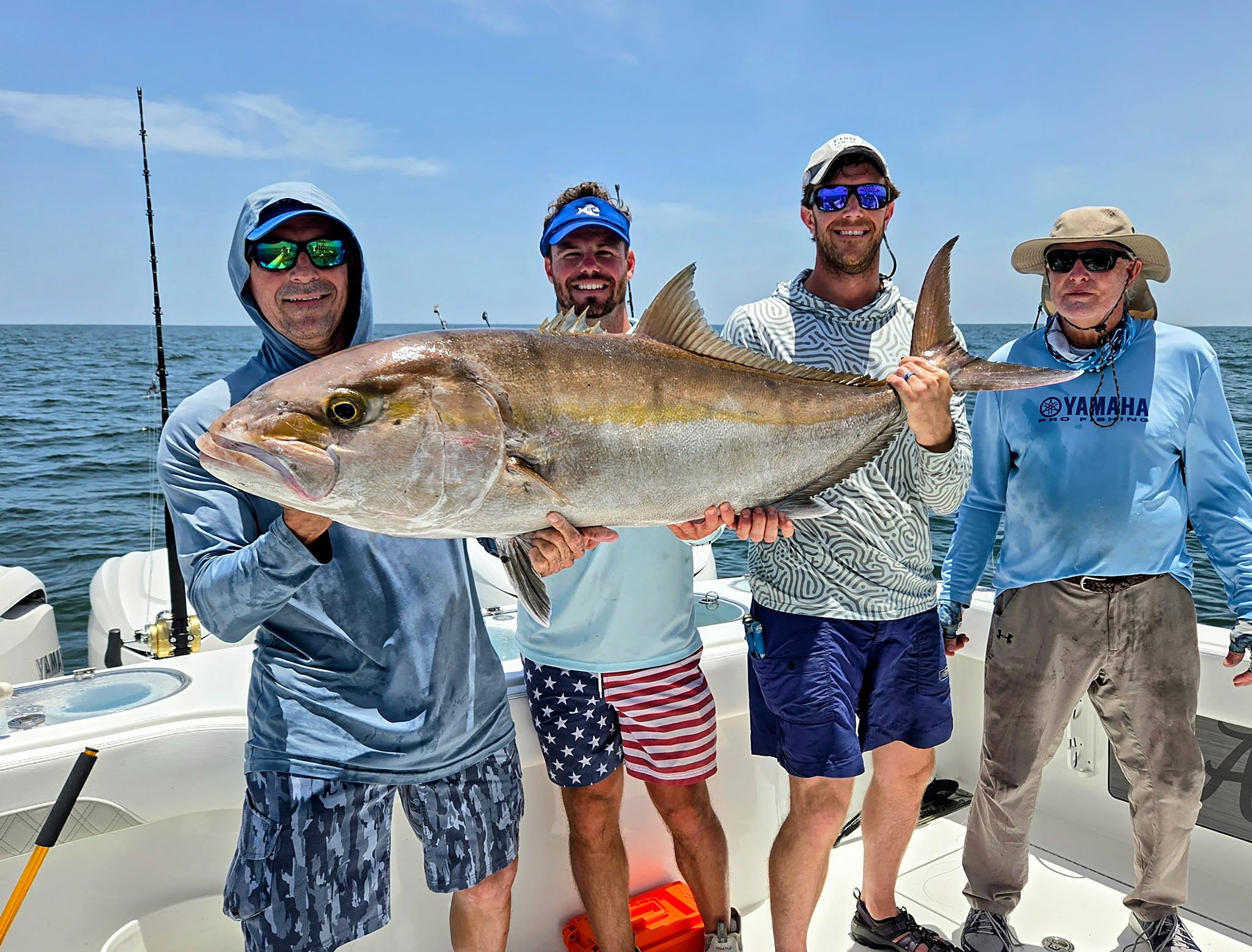
By DAVID RAINER, Alabama Department of Conservation and Natural Resources
The Great Red Snapper Count, utilizing new sampling gear and methods, estimated that far more iconic red snapper are in the Gulf of America than traditional assessment methods had indicated. A team of marine scientists used the same methodology to conduct the recent Greater Amberjack Count that produced similar results.
Dr. Sean Powers, Director of the Stokes School of Marine and Environmental Sciences at the University of South Alabama (USA), headed up the study that involves a dozen research entities from the south Atlantic and across the Gulf. On a break from his judging duties at the Alabama Deep Sea Fishing Rodeo (ADSFR) on Dauphin Island, Powers shared the findings of the multi-year study.
“For the last four years, we’ve been working on this project from North Carolina all the way to Texas to get an independent estimate on greater amberjack, similar to what we did for the Great Red Snapper Count,” Powers said. “The reason we focused on greater amberjack, especially in the Gulf, it is a stock that has supposedly been overfished and overfishing is occurring for decades.
“That really never made sense to us that it (overfished condition) could persist for so long. The (NOAA Fisheries) stock assessment has very little other data except for catch data.”
What Powers and his team wanted to do was gather fisheries independent data without the catch data. Congress appropriated $5 million to NOAA Fisheries and $5 million to the National Sea Grant College Program to conduct the amberjack study.
“We went out and measured population sizes on different reefs and different habitats where amberjack would occur,” he said. “We had 11 different institutions involved doing that for two years. The south Atlantic portion (North Carolina to Key West, Florida) of the stock that we found agreed with the stock assessment. We estimated there were 2.2 million greater amberjack 1-plus years old, and their estimate was 2.1.
“But when we moved to the Gulf, the latest stock assessment by the feds says there are 1.5 million greater amberjack. What we found was 3.2 million, so roughly double what the stock assessment says. Our estimates were what was matching up with the fishermen. Fishermen in the south Atlantic really didn’t have many concerns and it was open all year.”
However, it is a completely different story in the Gulf of America. Currently, no greater amberjack season has been set for 2026, and the previous seasons were set so that anglers would have something to catch when for-hire (charters) red snapper season is closed. The ADSFR, which is held on the third full weekend in July each year, hasn’t had an amberjack category in more than 15 years.
“In the Gulf, we’ve had shorter and shorter seasons, and the fishermen are asking why are we doing that because they are abundant,” Powers said. “Now there are some differences in the stocks in the Western Gulf, where they have really big amberjack, where ours are just above the legal limit (34 inches fork length).
“We hope our study will get reconciled with the stock assessment, because we don’t even have an amberjack season scheduled yet.”