It Takes a Village to Clean a River: Habitat restoration and mussel recovery on the Paint Rock

It Takes a Village to Clean a River

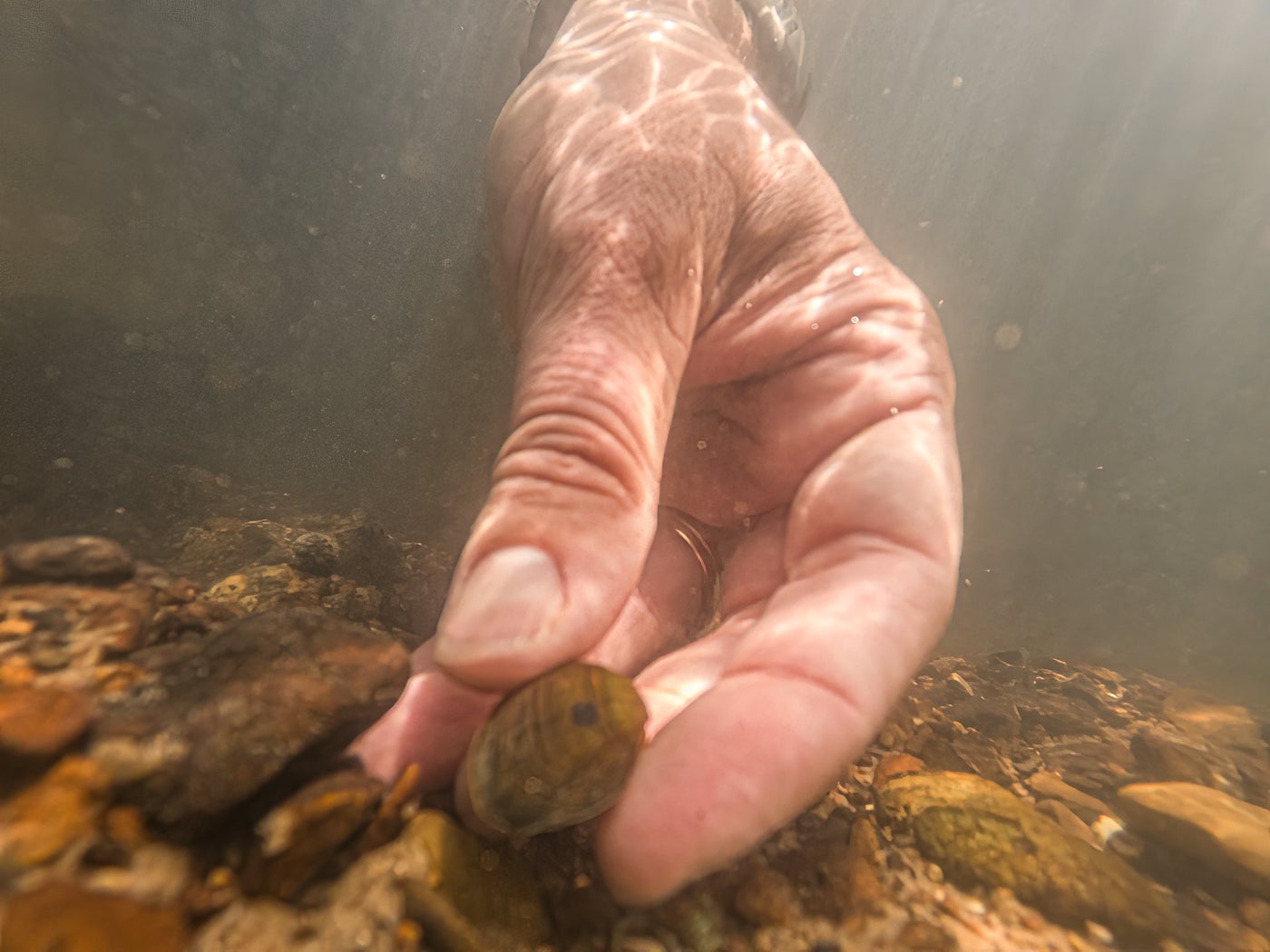
Approximatyly 1,500 rare native mussels were released in the Paint Rock River in northeast Alabama on August 25, 2026, as part of ongoing conservation efforts in the watershed. Photos by Billy Pope, ADCNR

By Kenny Johnson, Alabama Department of Conservation and Natural Resources

State and federal wildlife agencies, private conservation organizations and landowners have formed an important partnership focused on water quality restoration projects within the Paint Rock watershed in northeast Alabama. Those projects include streambank restoration, barrier removal and cleaning the river through the reintroduction of native mussels.

On Tuesday, August 25, 2026, representatives from the Alabama Department of Conservation and Natural Resources (ADCNR), the U.S. Fish and Wildlife Service (USFWS), The Nature Conservancy (TNC) in Alabama, the Alabama Rivers Alliance and the Beagle Charitable Foundation met in rural Jackson County for the release of approximately 1,500 rare native mussels into a section of the Paint Rock River that flows through the property of Huntsville businessman and Alabama Conservation Advisory Board member Raymond Jones, Jr. State Rep. Mike Kirkland and State Sen. Steve Livingston also attended the release.

“Partnerships like this are essential to our mission to conserve the state’s natural resources,” said Chris Blankenship, ADCNR Commissioner. “They bring together knowledge, resources and a shared commitment to protect Alabama’s lands, waters and wildlife. The work they are doing to improve water quality and habitat in the Paint Rock watershed is inspiring and will benefit communities along the river for generations to come.”

Native freshwater mussels and snails are important to healthy rivers and streams because they filter and clean water, recycle nutrients, provide food for other wildlife and help indicate the health of aquatic ecosystems by serving as an early warning system for declining water quality.

Dr. Paul Johnson, Director of ADCNR’s Alabama Aquatic Biodiversity Center (AABC), said the Jones property is a showcase site for restoration efforts on the Paint Rock.

“We’re releasing about 1,500 mussels today,” Johnson said. “Two are endangered species, the Pale Lilliput and Tennessee Bean, and one that’s proposed for listing, the Cumberland Moccasinshell. Both the Pale Lilliput and Tennessee Bean were among 20 species of freshwater mussels first listed as endangered by the U.S. Fish and Wildlife Service in 1976. There is a proposed rule for Cumberland Moccasinshell. It remains in only two places in Alabama. This will be the first release of Cumberland Moccasinshell in the middle Paint Rock. These releases are an ongoing attempt to reintroduce the Tennessee Bean and expand Pale Lilliput and Cumberland Moccasinshell in the Paint Rock River.”

AABC Director Dr. Paul Johnson (left) explains the importance of mussels to aquatic ecosystem to Sen. Steve Livingston, Rep. Mike Kirkland and ADCNR Deputy Commissioner Charlanna Skaggs.

AABC Director Dr. Paul Johnson (left) explains the importance of freshwater mussels to Sen. Steve Livingston, Rep. Mike Kirkland and ADCNR Deputy Commissioner Charlanna Skaggs.

Expanding where these species occur is necessary to meet the USFWS formal recovery criteria, so the species might eventually be delisted from the Endangered Species Act. Since 2010, the AABC has released more than 23,000 mussels at the Jones property site and 53,000 mussels representing six species throughout the Paint Rock River. In addition to the Tennessee Bean, Pale Lilliput and Cumberland Moccasinshell, the AABC has also released the Alabama Lampmussel, Oystermussel and Birdwing Pearlymussel into the Paint Rock.

“Our partners in this project have worked directly with the landowners to repair a lot of the damage that was done to the river in the past,” Johnson said. “One reason some of these species were listed was because of a channelization project here in the 60s that disturbed and moved the river. The habitat restoration work on the Paint Rock is helping landowners recover from some of the damage that was caused by that channelization project. Once the habitat has stabilized, that allows us to come in and complete the species recovery work with the goal to move them towards downlisting from the Endangered Species Act.”

Established in 2004, the AABC is the largest state nongame recovery program of its kind in the U.S. Its mission is to promote the conservation and restoration of rare freshwater species in Alabama waters and restore cleaner water in the state’s waterways. The reintroduction and recovery efforts provide leverage to other partners in pursuit of habitat recovery projects in critical watersheds statewide. The AABC is also working with other state natural resource agencies, primarily the Tennessee Wildlife Resources Agency, on reintroduction efforts where the animals once were in Tennessee as well.

The Paint Rock is one of the most biodiverse watersheds in North America. At just under 59 miles in length and occupying only 460 square miles, the Paint Rock River and its watershed support more than 150 different tree species, nearly 100 native freshwater fish species and 52 freshwater mussels species, including 12 listed under the Endangered Species Act.

Representatives from the The Nature Conservancy and the Alabama Rivers Alliance planting rare native mussels in the Paint Rock River.

Representatives from the The Nature Conservancy and the Alabama Rivers Alliance planting rare native mussels in the Paint Rock River.

In 1994, TNC’s Alabama Chapter established the Paint Rock River Initiative to begin habitat restoration efforts in the watershed. Over the next two decades, 45 streambank and channel restoration projects were completed through the cooperative efforts of the ADCNR, USFWS, TNC, Tennessee Valley Authority, Jackson County, USDA Natural Resources Conservation Service and private landowners.

Additionally, these partnerships have secured 38,000 acres of public lands to support conservation efforts in the Paint Rock watershed and increase access to outdoor recreation, including ADCNR’s Skyline Wildlife Management Area and various Forever Wild properties like the popular Walls of Jericho tract, USFWS’s Paint Rock River National Wildlife Refuge in Tennessee, and TNC’s Roy B. Whitaker Preserve, Keel Mountain Preserve, and Paint Rock Forest Research Center.

The Paint Rock meanders for a little more than 3 miles through Jones’ nearly 5,000 acres. In the late 1960s, the U.S. Army Corps of Engineers implemented a program to straighten sections of the upper Paint Rock where parts of the river were artificially channelized in an attempt to diminish flooding events.

The channelization project triggered severe bank loss and erosion throughout the watershed, causing damage to property and the loss of acreage for landowners. Jones’ father, Raymond Jones, Sr., built a levy along a section of the river on their property in the late 70s and early 80s to protect against the damage. River restoration projects began at the Jones site in 2012, and two streambank stabilization projects were completed in 2017 and 2019. These river restoration projects have made the Jones property an important location for AABC’s mussel recovery efforts on the Paint Rock River.

Jones said the river has changed for the better over the last two decades thanks to the partnerships working to restore it.

The Paint Rock is one of the most biodiverse watersheds in North America

The Paint Rock is one of the most biodiverse watersheds in North America.

“I think the river is the lifeblood to the whole valley and brings together a variety of people and supports an incredibly diverse habitat for so many species of wildlife,” he said. “The river itself is healthier today than it was when I was kid. The Nature Conservancy and the Conservation Department’s Wildlife and Freshwater Fisheries (WFF) Division have been great partners. It would be very difficult to do this on your own as a landowner. These partnerships are everything.”

More than 95 percent of land in Alabama is privately owned, making private landowner participation in restoration and recovery projects essential to conservation. Partnerships between state, federal and private conservation organizations and landowners like Jones are critical to ensuring the health and sustainability of the state’s natural resources.

The USFWS Partners for Fish and Wildlife Program helps support these types of conservation efforts by providing free technical and financial assistance to individual landowners and organizations interested in improving wildlife habitat on their land. Since 1987, USFWS has helped more than 25,000 landowners complete more than 40,000 projects, restoring more than six million acres of forest, prairie, wetland and stream habitat throughout the U.S.

“For more than 25 years, the Paint Rock River Basin has been a priority watershed for us,” said Jeff Powell, Acting Field Supervisor for the USFWS's Alabama Ecological Services Field Office. “Our goal is to work with private landowners and other agencies and conservation groups to provide positive conservation opportunities for willing participants. Of the more than 40 projects that have been implemented in the Paint Rock River over the last 25 years, Mr. Jones’ property has always been special for multiple reasons. First, because he has always been such a faithful and willing partner and second, the presence of numerous trust resources including several federally protected freshwater fishes and mussels on this property make it a priority.”

Partnerships are essential to conserving Alabama's natural resources. Left to right: AABC Director Paul Johnson, Sen. Steve Livingston, Raymond Jones, Rep. Mike Kirkland, and ADCNR Deputy Commissioner Charlanna Skaggs.

Partnerships are essential to conserving Alabama's natural resources. Left to right: AABC Director Paul Johnson, Sen. Steve Livingston, Raymond Jones, Rep. Mike Kirkland, and ADCNR Deputy Commissioner Charlanna Skaggs.

During the mussel release, ADCNR Deputy Commissioner Charlanna Skaggs thanked Jones for making his property available for AABC’s recovery efforts.

“Raymond has been an incredible partner in the restoration work of the Paint Rock watershed,” Deputy Commissioner Skaggs said. “He and his father have served on various boards associated with the Conservation Department, including the Conservation Advisory Board and the Forever Wild Land Trust, and this is one of those projects where the state can partner with private landowners and do some really great work together. We are grateful for his stewardship of this section of the Paint Rock.”

Amy Silvano, Chief of WFF's Nongame Resources and Wildlife Health Section, said much of the species recovery work on the Paint Rock depends on habitat restoration efforts and could not be accomplished without support from the State Wildlife Grant Program. Mandated by Congress in 2000, the State Wildlife Grant Program provides states with funding for proactive conservation efforts for species of greatest conservation need and their habitats.

“The State Wildlife Grant Program was established to support a wide range of conservation activities, including research, surveys, restoration and habitat management for species of greatest conservation need,” Silvano said. “Each state is required to develop a comprehensive State Wildlife Action Plan to remain eligible for program funding. Among other conservation projects, this funding helps support the Aquatic Biodiversity Center. Paul and his team play a critical role in implementing Alabama’s State Wildlife Action Plan by developing and restoring populations of species of greatest conservation need throughout the state, including today’s mussel release at the Paint Rock.”

State Rep. Mike Kirkland, who represents Jackson County in House District 23, said the mussel release in the Paint Rock at the Jones property is an ideal model for conservation efforts within the watershed.

“As a lifelong resident of Jackson County, I’ve had the privilege of knowing and spending time on this land for many years, and seeing it preserved is something that means a great deal to me personally,” Rep. Kirkland said. “What we witnessed during the mussel release is an important investment in the future of our community and the state of Alabama. Restoring this land will allow nature to do what it does best—help clean and protect our river, provide valuable habitat for wildlife and conserve a place that is incredibly diverse biologically. This is the kind of conservation that benefits everyone, including our residents, our landowners, our outdoor heritage and future generations who will have the opportunity to experience this remarkable part of Jackson County.”

State Sen. Steve Livingston represents Senate District 8, which covers Jackson and Madison counties and portions of DeKalb. He is excited to see the legacy of the river protected through the restoration and conservation efforts of the partner organizations working together on behalf of the watershed.

“Attending the mussel release was a special day for me because this is land I’ve known and spent time on for many years,” Sen. Livingston said. “Growing up in Jackson County, I’ve always understood how important this river and the surrounding land are to our community—not just for the people who live and work here, but for the wildlife and natural resources that make this area so unique. By allowing this land to work naturally to filter and clean the river, we’re investing in cleaner water, healthier habitat and a stronger future for Jackson County and the entire state of Alabama. I’m proud to see something that has been such a meaningful part of our community preserved for the generations who come after us.

“We are so proud to have the Alabama Department of Conservation and Natural Resources, the U.S. Fish and Wildlife Service, The Nature Conservancy, along with Raymond Jones and Mark Yokley representing the Jones family, working together to help preserve and restore the Paint Rock watershed. It takes partnerships like these and people who truly care about this land to make lasting conservation possible.”

Native freshwater mussels filter and clean water, recycle nutrients and provide food for other wildlife.

Native freshwater mussels filter and clean water, recycle nutrients and provide food for other wildlife.

In addition to improving habitat along the river and repairing damage to landowner property, the restoration and recovery efforts are yielding positive results for the animals that are doing the heavy lifting to clean the river. Since AABC’s mussel recovery efforts began, some of the reintroduced animals have established reproducing populations.

“We’ve verified recruitment in the middle and lower Paint Rock for Pale Lilliput, Birdwing Pearlymussel, Oystermussel and Alabama Lampmussel,” Johnson said. “Working with the Tennessee Wildlife Resources Agency, we’ve reintroduced Pale Lilliput into five different locations, and we have established reproducing populations in three of those sites. We’ve also reintroduced the Cumberland Moccasinshell to Bear Creek in Colbert County and it is reproducing. That’s how we’re going to meet the recovery criteria, by completing reintroduction efforts in multiple states simultaneously. The kicker is that this helps push the clean water effort forward and improves the property for landowners.”

###

Additional Information

Back To News