
WFF Receives Award for DeKalb County Lake Renovations

bass

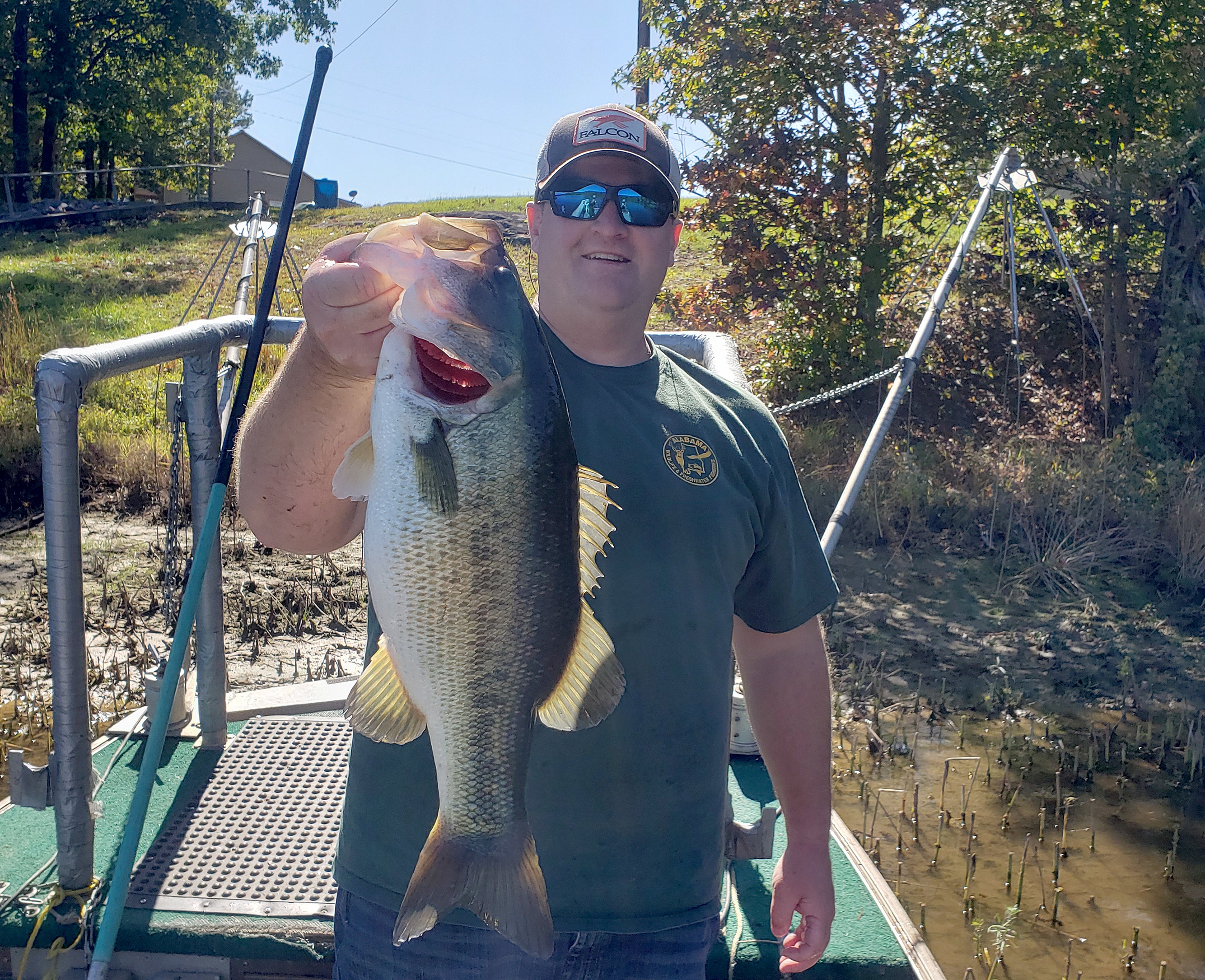
WFF District II Fisheries Supervisor Mike Holley shows off the size of bass that live in DeKalb County Lake. WFF photo

By DAVID RAINER, Alabama Department of Conservation and Natural Resources

The Alabama Department of Conservation and Natural Resources’ (ADCNR) Fisheries Section of the Wildlife and Freshwater Fisheries (WFF) Division received national recognition this week for its wise use of Sport Fish Restoration Funds.

The American Fisheries Society Fisheries Administrator Section awarded WFF’s District II Fisheries staff with the 2025 Sport Fish Restoration Outstanding Project Award for the project titled Managing for Quality Bass Fishing in a State-Owned Public Fishing Lake: A Case Study of DeKalb County Lake in Alabama.

Matthew Marshall, WFF’s Chief of Fisheries, nominated his team because of the extensive work at DeKalb County Public Fishing Lake (PFL), a 120-acre lake in northeast Alabama owned and managed by WFF.

Marshall said after decades of poor fishing and a decline in angler trips, the decision was made to drain and restock the lake. Fisheries Section research revealed many PFLs were dominated by smaller fish, which was caused by overfishing – not overcrowding – of bass. This was cited as the reason the fish did not reach larger sizes.

Renovations were done in 2014-2015, and DeKalb County PFL re-opened in 2016 with the goal of developing a high-quality bass fishery.

“This project aimed to provide a superior angling experience by maximizing the chances of catching large bass, supporting both recreational fishing and local economic benefits,” Marshall said. “Before the renovations, it was an underutilized lake; fishing wasn’t great and usage was low. We decided to drain it and restock it, and through our applied fisheries management techniques, we created a quality bass fishery.”

DeKalb County PFL averages about 15 feet deep. During the summer, distinct water layers form between 6-9 feet deep, separating the water by temperature (thermocline) and chemical makeup (chemocline). Marshall said largemouth bass fingerlings were stocked at a rate of 100 per acre of nearshore habitat, which translated into roughly 30 fish per surface acre, providing optimal opportunity for the fingerlings to reach quality size. Put simply, the lake now has the right number of bass for that amount of water, ensuring they grow big.

While the lake was drained, abundant trees and woody structure were installed, and gravel beds were added to improve bluegill spawning. After the lake was refilled, moderate amounts of emergent shoreline vegetation (water willow) were maintained to provide ideal habitat for bass and bluegills.  The lake was fertilized, and fingerling bluegills were stocked annually as a supplemental food source for the bass.

“One of the most important things we accomplished was providing a ton of fish habitat on the front end of the renovation,” said Mike Holley, WFF’s District II Fisheries Supervisor. “Moving large trees into the lake and cutting ditches with bulldozers, spreading gravel for spawning substrate and other work with heavy equipment made a big difference in available habitat.”

Chris Blankenship, ADCNR Commissioner, said additional work going on at DeKalb will make the lake much more attractive to anglers and families.

“The Department is spending more than $600,000 right now to renovate the piers and make other access and fishing improvements to DeKalb County Lake,” Commissioner Blankenship said. “The fishing is great at the lake, and these improvements will make the amenities great as well.” 

kid

The DeKalb County Lake bass fishing is great for the whole family. WFF photo

From 2016 to 2020, a strict catch-and-release regulation for largemouth bass was enforced to protect the population and allow fish to reach larger sizes. In spring 2020, the regulation was changed to allow the daily harvest of 5 bass under 13 inches per angler. Marshall said creel survey data was collected to compare pre- and post-renovation angler satisfaction and demographics at the lake. 

“We saw permit sales double,” Marshall said. “The public was happy. We had some strict regulations with the primary objective of offering a memorable angling experience with a high probability of catching large bass. Michael Holley and his staff deserve all the credit.” 

Marshall said the DeKalb PFL bass fishery has developed well and is noticeably different after renovation, with larger bass much more abundant. Comparing the five years before the renovation, 2009-2013, to the five years from 2020-2024, the number of quality-sized bass greatly increased.

“Anglers have caught numerous, numerous 10-pound bass out of that lake,” he said. “I consider Mike Holley’s decisions on stocking rates, the management, the regulations and education of the public is what made this such a success. We let the public know that if they followed these regulations we could sustain quality bass fishing longer.

“The locals seemed to try to keep things quiet, but permit sales don’t lie. They went up substantially. DeKalb is in our top four or five in terms of permit sales.”

Marshall said of the anglers interviewed in 2020, 68% were from DeKalb County compared to 83% in 2013, indicating that more non-local anglers are being attracted to the lake. He said strict enforcement and angler education on the bass catch-and-release regulation, aided by the lake manager, has been an important factor in the success of the fishery. 

Marshall said the successful renovation of the DeKalb PFL through innovative management strategies has also contributed to the local economy with the increase in non-local angler participation. 

“This award for Mike Holley and our District II staff is a big deal to me,” Marshall said. “It reinforces that by using these applied fisheries management techniques, we can make a difference. The purpose of Sport Fish Restoration funding is to make fishing better and restore fisheries.

“Despite the 10-pound bass, we really weren’t managing for trophies, just quality fish. Some places are managing for trophy fish, which is fine, but that was not our goal. My interpretation of Sport Fish Restoration funding is to make fishing better for everyone. I think this project did that.”

Another benefit of managing for a quality bass population is that it takes a great deal of pressure off the bluegill.

“Bluegill catch rates went up, which is another data point we were looking at,” Marshall said. “A population of large fish (bass) allows more bluegills to survive. When you have a lot of small bass, they eat a lot of bluegills. We now have a nice population of bluegills at DeKalb. Catch rates are high.”

WFF maintains 23 Public Fishing Lakes throughout the state. Marshall said Marion County PFL is undergoing a $2 million renovation, which should be completed this fall. Crenshaw County and Escambia County PFLs are scheduled to reopen next spring. Visit www.outdooralabama.com/where-freshwater-fish/state-public-fishing-lakes for more information. Click on the interactive map for links to each individual public fishing lake.

###

lake

A great deal of dirt work and adding structure during renovation is paying off at DeKalb County Lake. WFF photo

Written by

David Rainer
Outdoor Writer
Back To News